Rust, Remediation, and Really Good Fishing: The Second Life of the Hudson's Forgotten Waterfronts
Stand at the edge of the renovated waterfront in Beacon, New York on a Saturday morning and you'll see something that would have been unthinkable thirty years ago: a guy in waders casting for striped bass where a brick chimney stack used to throw shadows over a crumbling hat factory floor. Kids are poking around in the shallows. A kayaker glides past a restored wetland fringe thick with cattails. A great blue heron stands on a repurposed concrete pier like it owns the place.
It does, kind of. So does everyone else now.
Across the Hudson Valley, a quiet revolution is reshaping the river's edge. Post-industrial sites that spent generations locked behind chain-link fences — contaminated, forgotten, or simply ignored — are getting a second act. And the people who love this river are the ones reaping the rewards.
The Industrial Hangover
The Hudson River's industrial history is written in its shoreline. From the iron foundries of Cold Spring to the brick kilns of Kingston, the cement plants of Rosendale to the sprawling rail yards of Yonkers, the river wasn't just a scenic backdrop for 19th and early 20th century industry — it was the engine. Factories needed water for cooling, for transport, for waste disposal. And when those industries finally collapsed under economic pressure and changing markets, they left behind something complicated: contaminated soil, crumbling infrastructure, and miles of riverfront that nobody could legally or safely use.
"These sites became a kind of no-man's-land," says Marcus Delgado, a Hudson Valley environmental historian who has spent years documenting post-industrial waterways. "The public lost access to enormous stretches of the river. The ecology suffered. And the communities that used to depend on those industries were left holding the bag."
For anglers, it was a particular kind of frustration. Some of the most structurally promising fishing habitat on the river — deep bends, submerged foundations, warm-water discharge zones — sat behind fences and warning signs. You could see the water. You just couldn't get to it.
Cleaning Up, Opening Up
The brownfield remediation process is slow, expensive, and not exactly glamorous. But when it works, the results can be genuinely transformative.
The basic idea is this: contaminated industrial sites are assessed, cleaned to federal and state standards, and then — ideally — returned to productive community use. In the Hudson Valley, a combination of EPA Superfund designations, state Brownfield Cleanup Program incentives, and nonprofit advocacy has accelerated the pace of remediation over the past two decades.
Developers like Riverfront Restoration Partners, a Poughkeepsie-based firm that has worked on several Hudson sites, say the economics have shifted considerably. "There was a time when nobody wanted to touch these properties," says project manager Elena Chu. "The liability exposure was too high, the cleanup costs were too uncertain. What changed is a combination of better regulatory frameworks, more available grant funding, and honestly — a growing public appetite for waterfront access. Communities started demanding it. That changes the calculus."
The results on the ground are striking. In Hudson, New York, a former cement terminal that sat vacant for nearly forty years has been transformed into a public waterfront park with fishing piers, a boat launch, and restored native plantings along the bank. In Newburgh, a contaminated industrial parcel that once housed a manufactured gas plant now anchors a waterfront revitalization project that includes public fishing access and a kayak launch. In Yonkers, the redevelopment of the former Alexander Smith Carpet Mills site has opened up previously inaccessible stretches of the Saw Mill River — a Hudson tributary — to recreational users for the first time in living memory.
What the Fish Think
Here's the thing about remediated waterfront sites: the fish were often already there, working around the mess.
Submerged foundations, old pilings, and collapsed industrial structures create the kind of complex underwater habitat that fish love. Striped bass, largemouth bass, white perch, and catfish all gravitate toward structure. When contamination is removed and water quality improves, these spots don't just become fishable — they often become exceptional.
"I've been fishing the Hudson for thirty-something years," says Tony Ferraro, a longtime angler from Haverstraw who has watched several former industrial sites come back online. "Some of these spots that opened up in the last ten years? They're legitimately among the best on the river. There's a spot near an old brick yard that I won't name — and I'm sure half your readers know exactly what I'm talking about — where the stripers just stack up in the fall. The old pilings are still down there. The fish love it."
Wildlife biologists confirm the pattern. Remediated sites with preserved or restored structural complexity tend to recover quickly. In some cases, they become disproportionately productive relative to their size, functioning as de facto fish aggregation zones.
More Than Just Fishing
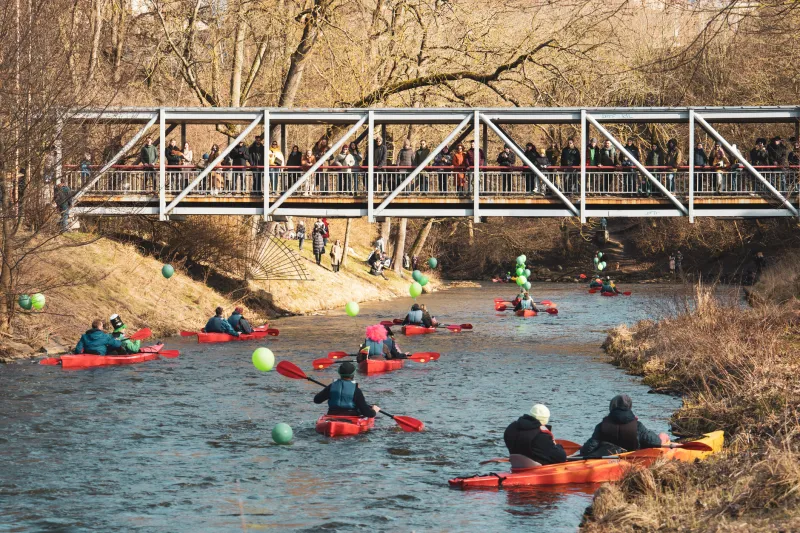
The transformation of these sites isn't only a story for anglers, though. Kayakers and paddleboarders are discovering new launch points in places where public water access was previously nonexistent. Birdwatchers are finding that restored riparian vegetation along former industrial banks attracts migratory species in impressive numbers. Families who live in adjacent neighborhoods — often lower-income communities that bore the brunt of industrial pollution without sharing in the economic benefits — are finally getting a piece of the river that was always technically theirs.
"That part matters a lot to me," says community organizer Priya Nair, who works with a Newburgh-based environmental justice nonprofit. "These weren't neighborhoods with country clubs or private docks. The river was right there and people couldn't use it. When a waterfront site opens up and it's actually welcoming — good signage, accessible paths, a fishing pier that doesn't require a car to reach — that's a meaningful quality-of-life change for real people."
The social dimension of waterfront reclamation is increasingly recognized by planners and developers as central to the value proposition. A remediated site that's technically open but practically inaccessible — poor transit connections, no amenities, no community programming — doesn't deliver the same returns as one that's actively integrated into neighborhood life.
What's Still Left to Do
For all the progress, the map of the Hudson's post-industrial shoreline is still dotted with sites that haven't been touched. Funding gaps, ownership disputes, and the sheer complexity of contamination at some locations mean the work is far from finished.
"We've made real progress," says Delgado, the historian. "But if you look at the full inventory of impaired or inaccessible waterfront sites in the Hudson Valley, we've probably addressed maybe a third of what needs attention. There's a long runway ahead."
For the angling and outdoor recreation community, that means continued advocacy matters. Showing up to public comment meetings, supporting organizations that push for brownfield funding, and making noise about the value of waterfront access — these things actually move the needle.
In the meantime, the spots that have already come back are worth celebrating. And fishing. Definitely fishing.
Next time you're casting from a pier that used to be a loading dock, or launching your kayak from a ramp that was once buried under industrial fill, take a second to think about how much work went into making that moment possible. Then enjoy every second of it — because that's exactly what the river is for.