Beavers, Eagles, and the Occasional Seal: The Wild Neighbors Reclaiming the Hudson River
There's a moment that stops just about every kayaker cold the first time it happens. You're drifting quietly near a marshy cove somewhere north of Poughkeepsie, paddle resting across your lap, when something surfaces about twenty feet off your bow. Sleek. Dark. Gone before you can fully process it. A river otter, most likely — an animal that was essentially absent from the Hudson Valley for most of the 20th century.
That's the thing about the Hudson River right now. It's full of surprises, and most of them have fur, feathers, or fins.
The river's decades-long environmental recovery — driven by the Clean Water Act, relentless advocacy, and a whole lot of community pressure — has done more than make the water safer for swimming and fishing. It's quietly rebuilt a functioning ecosystem that's drawing wildlife back from the margins. And if you know what to look for, you can witness it yourself any given weekend.
The Comeback Kids: Otters and Beavers Return
River otters are arguably the Hudson Valley's most exciting wildlife story of the past two decades. Sensitive to water quality and dependent on healthy fish populations, they vanished from most of the lower Hudson as pollution peaked in the mid-20th century. Now they're back — and biologists are cautiously thrilled.
"Otter sightings have become genuinely regular in places like Tivoli Bays and the wetlands around Staatsburgh," says one wildlife biologist who has tracked mammal activity along the mid-Hudson corridor for over a decade. "They're not common in the way deer are common, but we're seeing consistent evidence of established populations. That's a real signal of ecosystem health."
Beavers have made an even more dramatic return. Drive along the river on almost any rural stretch and you'll spot their engineering projects — dams tucked into tributaries, gnawed tree stumps at the water's edge, lodges rising from shallow backwaters. Beavers create wetland habitat that benefits dozens of other species, so their presence has a multiplying effect on local biodiversity.
Both animals are most active at dawn and dusk. If you want a sighting, paddle quietly into a sheltered cove around sunrise and give yourself at least thirty minutes of stillness. Patience is the price of admission.
Eyes in the Sky: Bald Eagles and Osprey
Look up. Seriously — look up more when you're on the Hudson.
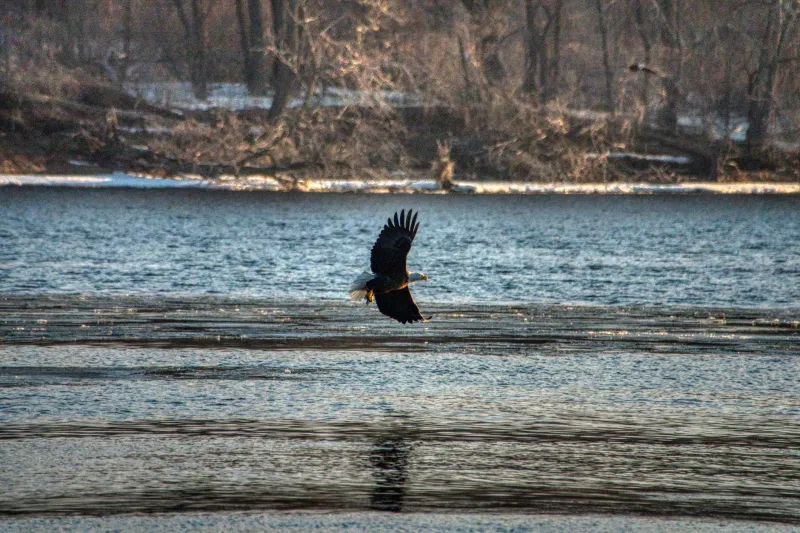
Bald eagles have established a thriving nesting population along the river, particularly from the mid-Hudson Valley northward. The Hudson River valley now supports one of the densest concentrations of nesting bald eagles in the northeastern United States, a recovery so complete it barely registers as news anymore. Which is kind of wild when you think about it.
Osprey are even more visible, and frankly more dramatic to watch. These fish-hunting specialists — sometimes called "river hawks" locally — hover over the water, spot a fish from thirty feet up, and then fold into a feet-first dive that looks like something out of a nature documentary. They've rebounded strongly since DDT was banned, and nesting platforms erected by conservation groups along the Hudson have given them a foothold in areas where natural nest sites were scarce.
For eagle watching, the stretch between Kingston and Hudson is reliably productive in winter, when eagles concentrate around open water and fish carcasses left by commercial operations. Riverfront parks like Olana State Historic Site offer elevated views that make spotting much easier. Bring binoculars — a good 8x42 pair will transform the experience.
Wait, Are Those Seals?
Yes. Sometimes, yes.
Harbor seals and the occasional gray seal have been documented making their way up the Hudson, sometimes as far as the Tappan Zee area and beyond. These aren't regular residents — they're opportunistic visitors following fish runs, typically appearing in late winter or early spring before heading back to coastal waters.
Sightings tend to cluster near the river's mouth and the lower Hudson, around Piermont and Haverstraw Bay, but there are documented reports of seals appearing much farther north. The New York State Department of Environmental Conservation encourages people to report unusual marine mammal sightings, and the Atlantic Marine Conservation Society (AMSEAS) maintains a stranding hotline for animals that appear to be in distress.
If you spot a seal hauled out on a rock or sandbar, the best thing you can do is watch from a distance and resist the urge to approach. Seals that appear to be resting aren't necessarily sick — they need to haul out to thermoregulate. Give them at least 150 feet of space and let them do their thing.
Herons, Egrets, and the Shorebird Scene
You don't have to get lucky to see spectacular wildlife on the Hudson. Great blue herons are practically furniture at this point — stately, patient, impossible to miss as they stand motionless in the shallows waiting for a fish to commit a fatal mistake. Great egrets have also expanded their range significantly as water quality has improved, their white plumage making them easy to spot from shore.
The tidal wetlands along the Hudson — places like Constitution Marsh near Cold Spring, Tivoli Bays near Bard College, and Iona Island near Bear Mountain — are genuinely world-class birding spots. During spring and fall migration, the diversity of shorebirds and waterfowl moving through can be staggering. Bring a field guide or download the Merlin Bird ID app from the Cornell Lab of Ornithology before you go. It's free and it will absolutely change the way you experience the river.
How to Be a Responsible Wildlife Watcher
The Hudson's wildlife resurgence is real, but it's also fragile. A few principles go a long way toward making sure these animals continue to thrive:
Keep your distance. The rule of thumb is simple — if an animal changes its behavior because of your presence, you're too close. Back off.
Stay quiet. This sounds obvious but it's easy to forget when you're excited. Loud voices and sudden movements push wildlife away and cause stress to nesting birds.
Don't feed anything. Ever. Feeding wild animals is harmful to them and can create dangerous habituation to humans.
Stick to established access points. Trampling through sensitive wetland vegetation to get a better view does real damage to the habitat these animals depend on.
Report what you see. Platforms like eBird (for birds) and iNaturalist (for everything else) contribute to citizen science databases that help researchers track population trends. Your sighting matters.
The River Is Telling You Something
Wildlife doesn't lie. When beavers build dams in a watershed, when otters return to a river system, when bald eagles nest year after year in the same valley — these are indicators that something fundamental has shifted. The Hudson River is not a finished restoration project. It's a work in progress, and it still carries the scars of industrial abuse that won't fully heal for generations.
But the animals coming back don't know about Superfund timelines or regulatory battles. They just know the water is cleaner, the fish are returning, and there's habitat worth living in.
Next time you're out on the Hudson — fishing, paddling, or just sitting on a dock watching the current move — take a minute to scan the margins. The coves, the mudflats, the snags of driftwood, the sky above the opposite bank. Your river is more alive than you probably realize. And it's just getting started.